
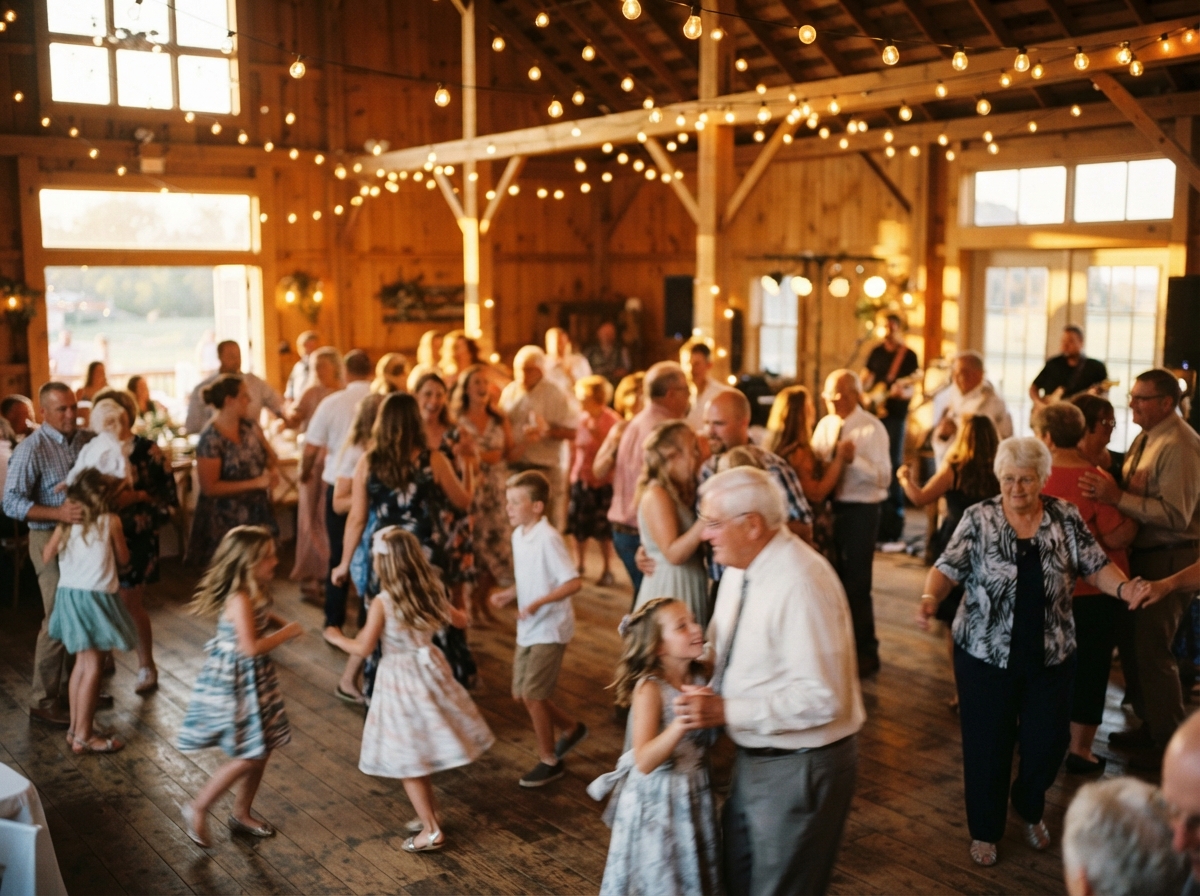
Most wedding receptions run about five to six hours from the start of cocktail hour to the last dance. That's the short answer — but the order of events, and how long you give each one, is what separates a reception that flows from one that stalls. Iowa Event DJ is a premium solo wedding and event DJ and MC serving all of Iowa, and one of the first things we build together is your timeline. Below is a step-by-step reception timeline with realistic time estimates you can use as a starting point. Every number here is a typical range, not a rule — your real timeline gets built around your venue, your guest list, and the moments that matter to you.
The quick version: a typical reception order
Here's the standard flow, start to finish. Time estimates assume a reception of roughly five to six hours.
- Cocktail hour — about 60 minutes
- Grand entrance and introductions — 5 to 10 minutes
- First dance — about 4 minutes (immediately after the entrance, or after dinner)
- Welcome and blessing — about 5 minutes
- Dinner — 45 to 60 minutes
- Toasts and speeches — 10 to 20 minutes
- Parent dances — 8 to 10 minutes
- A custom moment (an interactive segment or game) — 10 to 15 minutes
- Open dancing — 2 to 3 hours
- Last dance and send-off — about 5 minutes
Now here's what each block is actually for, and how to time it so the energy never sags.
Cocktail hour (about 60 minutes)
While you're taking photos, your guests are arriving, finding the bar, and settling in. This is background music — warm, easy, conversational — set at a level that lets people talk. It sets the tone before anyone thinks about a dance floor. Sixty minutes is the sweet spot: long enough for everyone to arrive, short enough that guests don't get restless waiting for you.
Grand entrance and introductions (5 to 10 minutes)
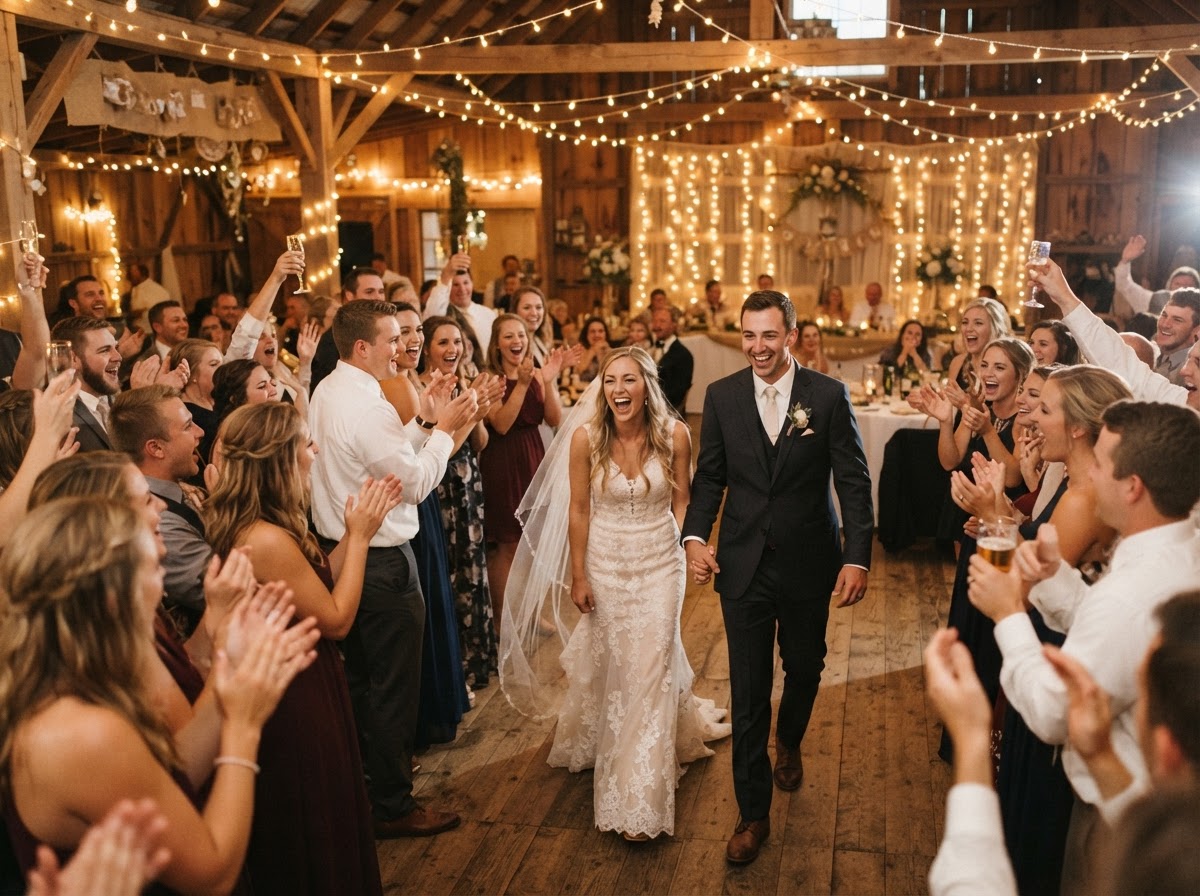
This is the first real energy spike of the night. Your wedding party and the two of you get introduced into the room, and how it's cued matters — the right song, the right timing, and an MC who reads the room and keeps it moving rather than dragging it out. Ten introductions handled crisply feels celebratory; the same ten handled slowly feels like a roll call.
First dance (about 4 minutes)
Many couples go straight from the entrance into the first dance while all eyes are already on them — it's clean, and it gets the first dance done while the room's attention is naturally focused. Others prefer to eat first and dance after dinner. Both work. The only wrong version is leaving it unplanned so nobody knows when it's coming.
Welcome and blessing (about 5 minutes)
A brief welcome from the couple, a parent, or an officiant, and a blessing before the meal if you'd like one. Short and warm. This is also the natural moment to invite guests to their seats and cue the caterer.
Dinner (45 to 60 minutes)
Music comes down to a comfortable dinner level, and the two of you get a moment to actually eat. Behind the scenes, this is when your DJ, photographer, caterer, and coordinator confirm the back half of the timeline so the transition out of dinner is seamless. A good rule: plan for about 45 minutes for a plated dinner and closer to 60 for a buffet, since buffet lines take time.
Toasts and speeches (10 to 20 minutes)
Toasts land best either during dinner (between courses) or right after, while people are still seated and attentive. Two to four speakers is the comfortable range — enough to honor the people who matter, short enough to keep the room with you. Your DJ handles the microphone handoffs so no one is fumbling for a mic, and keeps the pacing tight.
Parent dances (8 to 10 minutes)
Father-daughter, mother-son, or whatever version fits your family. These are the emotional bridge between the seated portion of the night and open dancing — they pull the room's attention back to the floor and set up everything that follows.
A custom moment (10 to 15 minutes)
This is the difference between a nice reception and one your guests still talk about a year later. A custom moment — an interactive segment designed with you in advance — drops in right around here, between dinner and open dancing, to re-energize the whole room before the floor opens up. The flagship version is a live bridesmaids-versus-groomsmen game show, Family Feud–style, built into the reception because the couple and their DJ designed it together. It gets everyone laughing, including the guests who weren't planning to dance, and it hands the momentum straight to the dance floor.
Open dancing (2 to 3 hours)
This is the heart of the night and where the plan gives way to the read. Your must-plays and do-not-plays are the rails; from there, the floor gets read in real time — country to hip-hop to polka in the same set if that's what your crowd is — with a live guest request platform letting your people steer from their phones. If a song isn't landing, it doesn't get ridden out. Twenty-five years of reading Iowa rooms says the floor comes back fast.
Last dance and send-off (about 5 minutes)
One final song — sometimes just the two of you, sometimes everyone circled up — and an exit if you've planned one. A strong last dance sends people home on the high note the whole night was building toward.
Why the timeline is a starting point, not a script
Here's the part most timeline guides skip: the schedule is the rails, not the whole night. The most common way a reception ends early is over-programming it — locking every song and every minute in advance with no room to read the floor. A reception once arrived pre-programmed to the second, with no reads and no audibles, and the dance floor died before the night was over. The lesson, learned the hard way: plan the moments together, then trust the professional to read the room between them. Total control kills dance floors; collaboration plus live authority fills them.
How your DJ builds this with you
Your real timeline gets built in the Blueprint — the collaborative planning portal where your timeline, must-plays, do-not-plays, and a taste profile of your specific crowd all come together weeks before the wedding. Every wedding rate includes up to eight hours of music, which covers this entire timeline start to finish with room to spare, and overtime is your call in the moment if the night's still rolling. Nothing about your reception is improvised from zero — and nothing is so locked down that the floor can't breathe.
About Iowa Event DJ: a premium solo wedding and event DJ and MC serving all of Iowa — including Des Moines, Cedar Rapids, Iowa City, Dubuque, Ames, and Fort Dodge — with transparent published pricing, a collaborative planning process, and 25 years of open-format experience. One DJ, planned together and read live: the DJ you meet is the DJ behind the booth.
Want to see how the plan and the live read fit together? Here's the full three-phase process, here's what a wedding here includes and why couples pay $2,500, and here's the flagship wedding experience in full.
Let's build your timeline together. The person who answers is the DJ.
Check your date →
Planning
Making your event unforgettable: the moments guests still talk about
The custom moments — reveals, game-show receptions, reinvented traditions — that turn a good night into the one people remember.
Read the post →
Planning
Common Iowa wedding questions, answered straight
Timeline, overtime, do-not-play lists, what happens if it rains — the questions that come up on nearly every call.
Read the post →
Planning
How planning together makes your reception feel like yours
Why nothing about your night is improvised from zero — and how the blueprint comes together weeks before the first dance.
Read the post →